Category: Blogs

Musculoskeletal Symptoms & the Menopause

Read our recent published article  on Musculoskeletal Symptoms and  the Menopause (painful stiff ,joints , painful hands , numbness / tingling in the hands , reduction in muscle quality and mass ,  muscle aches & pains,  impact on bone health including osteoporosis  to name a few effects of reduced   oestrogen and testosterone levels  . The article describes  the impact of menopause and how to  maximise overall musculoskeletal health for perimenopausal and menopausal women .https://www.scholarena.com/article/Musculoskeletal-Symptoms-in-Menopause.pdf

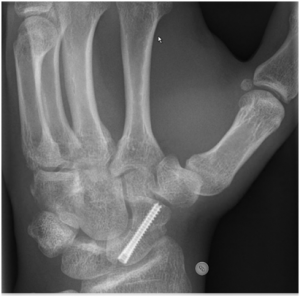
Missed Scaphoid fractures


Scaphoid fractures are commonly missed . I see at least one missed fracture every month and this is the result of several factors . The signs and symptoms of scaphoid fractures can be unimpressive and frequently patients as well as health care professionals think that the injury is simply a ‘sprain’ . Any fall onto or impact to the wrist (eg goalkeeper saving a football) resulting in pain / aching to the base of the thumb area should be reviewed by a healthcare professional , appropriate imaging performed  (scaphoid view XRs or MRI if normal XRs) and protected in a splint until a fracture is excluded .

MRI is the gold standard investigation of choice and XRs can indeed be normal

Most scaphoid fractures will heal uneventfully in a plaster or splint but certain fracture patterns have a tendency to heal slowly or not unite at all . An expert will be able to advise which fractures should be considered for surgery (displaced ,  proximal pole, unstable oblique). Initial treatment can be straightforward (either supervised plaster immobilisation,  simple screw fixation ) but if a scaphoid fracture is  missed or diagnosis is delayed  , then surgery can be a bit more complex necessitating grafting and fixation . This is why it is important that a prompt and accurate diagnosis is made and and expert opinion obtained .


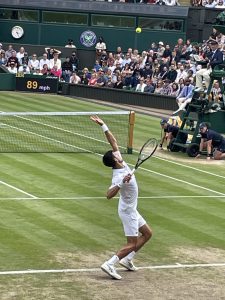
The Impact of Tennis on the wrist and hand


As SW19 warms up for annual tennis championship it is important to appreciate the impact of tennis on the hand and wrist.

Weekend warriors and elite tennis players alike will experience wrist pain from time to time  .  

Stroke generation requires a  complex kinetic chain involving transfer of large forces generated from the ground through the  feet , knees  , hip , pelvis , trunk , shoulders and ultimately through the hand and wrist . 

During the double-handed backhand,  the non-dominant wrist is subjected repeated extreme ulnar deviation and extension while dynamically moving from supination to pronation. The dominant wrist may also experience explosive load especially if the sweet spot of the raquet is missed !

Many tennis players present with ulnar sided wrist pain.  Common causes are TFCC (Triangular Fibrocartilaginous Complex ) and ECU (Extensor Carpi Ulnaris) injuries . The good news is that the vast majority of these will settle down with rest , splints, conditioning exercise especially it diagnosed promptly .

Diagnosis can be made after expert clinical assessment,  MRI or in some cases Ultrasound imaging . It is important that the correct investigation is performed and interpreted in the context of clinical presentation as sensitive investigations like MRI will flag incidental findings that might not to relevant.

For stubborn, ulnar sided wrist pain that has not settled despite a program of rehabilitation , a targeted steroid injection may play a role depending on the underlying pathology . 

Surgical treatment is a last resort when there is significant and persistent, painful instability having a major impact on the patient . 

More explosive loads can result in injury to the scapholunate ligament complex which plays an important role in wrist stability. It’s the wrist equivalent of the ACL ligament of the knee and if injured instability and pain can result. High grade scapholunate tears are generally more serious.  

Injury prevention is key and regular stretching , flexibility training , strength and conditioning which includes the upper limb  ( hand / wrist) is essential . Correct equipment selection is important-improper  grips , strings , size and weight of racquet can have an adverse effect and predispose the player to injury . 

The impact of Tennis on the Wrist & Hand

As SW19 warms up for the  Championships….


Weekend warriors and elite tennis players alike will experience wrist pain from time to time  .  Many professionals like Juan del Potro and more latterly Emma Raducanu have had issues around the wrist & hand. 

Stroke generation requires a  complex kinetic chain involving transfer of large forces generated from the ground through the  feet , knees  , hip , pelvis , trunk , shoulders and ultimately through the hand and wrist . 

During the double-handed backhand,  the non-dominant wrist is subjected repeated extreme ulnar deviation and extension while dynamically moving from supination to pronation. The dominant wrist may also experience explosive load especially if the sweet spot of the raquet is missed !

Many tennis players present with ulnar sided wrist pain.  Common causes are TFCC (Triangular Fibrocartilaginous Complex ) and ECU (Extensor Carpi Ulnaris) injuries . The good news is that the vast majority of these will settle down with rest , splints, conditioning exercise especially it diagnosed promptly .

Diagnosis can be made after expert clinical assessment,  MRI or in some cases Ultrasound imaging . It is important that the correct investigation is performed and interpreted in the context of clinical presentation as sensitive investigations like MRI will flag incidental findings that might not to relevant.

For stubborn, ulnar sided wrist pain that has not settled despite a program of rehabilitation , a targeted steroid injection may play a role depending on the underlying pathology . 

Surgical treatment is a last resort when there is significant and persistent, painful instability having a major impact on the patient . 

More explosive loads can result in injury to the scapholunate ligament complex which plays an important role in wrist stability. It’s the wrist equivalent of the ACL ligament of the knee and if injured instability and pain can result. High grade scapholunate tears are generally more serious.  

Injury prevention is key and regular stretching , flexibility training , strength and conditioning which includes the upper limb  ( hand / wrist) is essential . Correct equipment selection is important-improper  grips , strings , size and weight of racquet can have an adverse effect and predispose the player to injury .